永住許可の要件厳格化再び、永住ガイドライン改定の徹底解説
永住ガイドライン改定に際してのコンチネンタル国際行政書士法人の見立て
2026/8/4に永住許可申請のガイドライン改定案が公表されました。改正ガイドラインは、パブリックコメント(一般の人たちの意見公募手続き)を経て、2027年4月から適用される見込みです。
後記の収入に関する要件、公共の負担になっていないかどうかの要件は2025年10月、その他は来年4月から適用する方針です。そして、収入に関する要件、公共の負担とならないことの要件は、改定日において申請中である
案件にも適用されます。コンチネンタルでは、随時速報をアップデートしていきます。
改定案は
- 日本人と同水準の年収を継続しているか?
- 上記年収で30年厚生年金を受給していた場合に得られる年金見込み額があるか(金融資産での補填も可)?
- 日本語能力N3以上あるか?
- 継続して日本にいるとは?
- 対象となる就労系在留資格などを明記
- 配偶者の在留期間短縮要件も結婚後3→5年に厳格化など
などの内容になっています。


- 国や地方自治体による入管への通報は義務ではなく、悪質な公租公課の滞納など取消事由に該当すると思った場合は必要かつ可能な範囲で入管に通報するとなっています。
- 例えば国保滞納などが問題化して(地元議員が騒いで)いる自治体などからは情報が入管に提供される可能性があります。
概要
申請人の最低年収基準が日本人の平均値以上に引きあがる
- 収入は世帯単位で審査されます。夫と妻といれば二人分です。しかし、家族滞在などの家族による資格外活動のアルバイト収入は含まれません。
- 高度人材の年収水準は日本人の平均(500万円台後半)より高いのが一般的ですので、通常はあまり影響は無いものと思われます。
- 他方で日本の大学教員や研究機関の研究者などは給与水準が高くないため影響がありえます。また、JETプログラムの国際交流員など国策で招へいしている人たちも収入基準の改定の影響を受ける可能性があります。
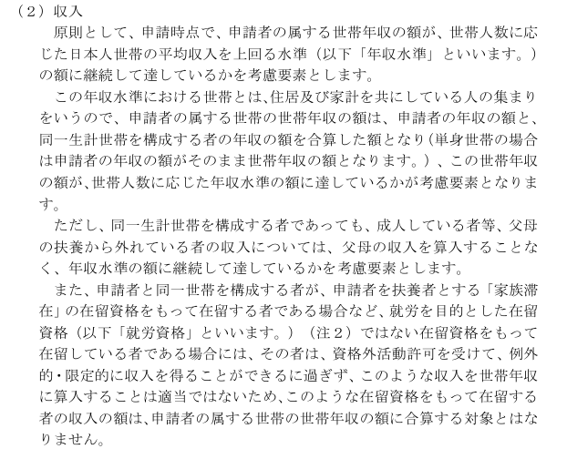
十分な年金見込み収入(日本人の平均以上の年収で30年加入したときと同等以上)
- 日本人の平均以上の年収で30年加入したときと同等以上が求められます。ただし、その他金融資産でカバー可能としています。
- 足らず米は金融資産でもよいとされているところ、求められる金融資産は年齢によって可変します。 若年層は少なくともよく、高齢者はたくさん求められます。例えば、平均寿命80歳として、必要な額-年金額×余命年数でしょうか。実務上どのくらいの金融資産が求められるかが肝になります。(例えば、年間200万円弱×20-30年分など)
- また、米国ソーシャルセキュリティ年金、退役軍人の恩給などの支給額は日本円で月60万円(例えば月額4000米ドルの場合)などを見込める場合も多く、それら日本の現役世代以上のもので、日本の低い水準の年金支給水準を大幅に上回ることから、申請人の支給金額の絶対額の高い外国年金への加入有無も考慮すべきです。

相応の日本語能力、社会への適合性
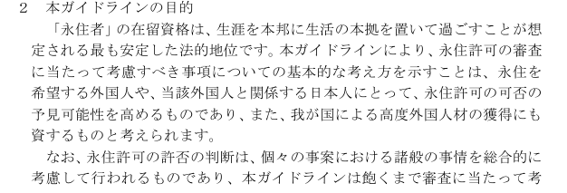
- 日本語能力試験N3以上(CEFR B1レベル)の日本語能力が求められます。
- ただし、高度人材は除外されています。そもそものコンセプトとして高度人材の獲得は命題であるためです。最先端テクノロジーで世界で伍していくために、各種研究機関や大学などの学者・研究員たち(公用語は英語)に追加的に日本語を学べというのもナンセンスなので、一部の学者やエグゼクティブなど一部の人は免責されます。

継続在留要件:1回の出国で半年以上、過去10年間通算して2年6か月以上の不在の場合は原則、不許可に
1回の出国で半年以上、過去10年間通算して2年6か月以上の不在の場合は原則、不許可になることが明記されました。また、いわゆる就活特活や起業活動を行うなどしているものは継続要件に入らないことが明記されました。


さらに、就労資格で在留していたとする「継続在留要件」の対象となる就労系在留資格から、インターンシップやいわゆる高卒特活(日本の高校を卒業して就職している者)は対象外とすることが明記されました。
いわゆる迷惑外国人の予防
- 地域社会に円滑に適応せず、問題を引き起こすおそれがある外国人に対して永住許可をすることは相当ではないため、申請者が、我が国の制度・ルール等についての理解が乏しい者や、これらを理解する意欲に欠ける者である場合には、不許可とします。
- 具体的には、出入国在留管理庁長官が指定する方法により、「生活・就労ガイドブック」に記載されている事項を中心に、我が国の制度・ルール等を理解しているかの確認を行い、その理解が一定水準以上に達しているかを考慮要素とします。
Continental Immigration’s Analysis of Japan’s Proposed Permanent Residence Guideline Revisions
On August 4, 2026, Japan’s Immigration Services Agency released a draft of the revised Permanent Residence (PR) Guidelines.
Under the proposal, the new income-related requirements are expected to take effect in October 2026, while the remaining revisions are scheduled to become effective in April 2027.
Continental Immigration will continue to monitor developments closely and provide updates as additional information becomes available.
Key Proposed Changes
The proposed guidelines introduce several significant new eligibility standards, including:
- Whether the applicant has continuously maintained an income comparable to that of the average Japanese worker.
- Whether the applicant is expected to receive retirement benefits equivalent to those of a person who earned the average Japanese income and contributed to the Employees’ Pension Insurance system for approximately 30 years (with financial assets potentially supplementing any shortfall).
- Whether the applicant possesses Japanese language proficiency at JLPT N3 (CEFR B1) level or above.
- Stricter requirements for spouses seeking reduced residence periods prior to PR eligibility, including extending the required period of marriage from three years to five years.
Proposed Revisions to the PR Revocation Guidelines
At the same time, the government has also proposed revisions to the guidelines governing the revocation of Permanent Residence.
Under the draft, national and local governments will not be legally obligated to report Permanent Residents to the Immigration Services Agency. However, where authorities believe that conduct may constitute grounds for revocation—such as serious or persistent non-payment of taxes or social insurance contributions—they may report such information to Immigration to the extent necessary and practicable.
For example, municipalities where delinquent National Health Insurance premiums have become a significant public policy issue may choose to provide such information to Immigration.
The Full Draft Is More Stringent Than the Summary Suggests
Although the government’s summary slides appear relatively concise, the full draft guidelines reveal substantially stricter standards.
1. Minimum Income Standard
The proposal would raise the minimum income threshold to a level at or above the average income of Japanese nationals.
For many Highly Skilled Professionals (HSPs), this change may have limited practical impact, as their salaries generally exceed the Japanese national average.
However, certain groups could be affected, including:
- University professors in Japan
- Researchers employed by public research institutions
- Participants in government-sponsored programs such as the JET Programme, whose salaries are often comparatively modest.
2. Adequate Retirement Income
Applicants would also be expected to demonstrate retirement income equivalent to that of an individual who earned at least the average Japanese salary and contributed to Japan’s Employees’ Pension Insurance system for approximately 30 years.
The draft indicates that financial assets may be used to supplement any shortfall. However, it remains unclear how much in liquid assets Immigration will consider sufficient in practice. Depending on future implementation, this could potentially require assets in the range of JPY 30–60 million, although no official benchmark has yet been announced.
Another important issue concerns foreign pension benefits.
Many applicants receive substantial retirement benefits from overseas systems, such as U.S. Social Security or U.S. military retirement pensions, which may significantly exceed typical Japanese pension payments. For example, monthly benefits of approximately USD 4,000 (roughly JPY 600,000, depending on exchange rates) are not uncommon.
In our view, Immigration should consider the actual amount of foreign retirement income, rather than focusing exclusively on projected Japanese pension benefits.
Conversely, the proposal could make it considerably more difficult for younger Highly Skilled Professionals, including recent graduates, to qualify for PR because they are unlikely to have accumulated either sufficient pension contributions or substantial financial assets.
3. Japanese Language Ability and Social Integration
Applicants would generally be required to demonstrate Japanese language ability at JLPT N3 (CEFR B1) level or higher.
Importantly, Highly Skilled Professionals are exempt from this requirement.
This exemption reflects the reality that many researchers, academics, and technology professionals work primarily in English at universities and research institutions. Requiring every internationally recruited scientist or executive to achieve additional Japanese proficiency would undermine Japan’s efforts to compete globally for highly skilled talent.
Continuous Residence Requirement
The proposed guidelines expressly state that Permanent Residence will, in principle, be denied if an applicant:
- remains outside Japan for more than six months on a single trip, or
- accumulates more than two years and six months of absence during the preceding ten years.
The proposal also clarifies that certain residence statuses—such as the Designated Activities status used for job-hunting after graduation or for start-up preparation—will not count toward satisfying the continuous residence requirement.
Furthermore, the draft specifies that several employment-related residence statuses will not qualify as eligible work statuses for purposes of satisfying the continuous residence requirement. These include:
- Amateur athletes,
- Graduates of Japanese universities holding the status under Ministry of Justice Notification No. 46, and
- Individuals working under the Designated Activities status commonly granted to graduates of Japanese high schools.
Continental Immigration will continue monitoring the legislative process and publish further analysis as additional details become available.