Japan HSP Visa Rules 2026: Salary and Points Changes
Japan Plans to Tighten Highly Skilled Professional Visa Criteria: Salary Thresholds and Points System Under Review
Japan Immigration Policy Update | October 2026
Japan is preparing to revise its Highly Skilled Professional (HSP) immigration framework, potentially making it more difficult for certain foreign professionals to qualify for one of the country’s most advantageous residence statuses.
The Ministry of Justice is considering higher salary benchmarks, adjustments to the existing points allocation, and the removal of certain bonus-point categories. The government reportedly aims to introduce regulatory amendments during the Japanese fiscal year ending March 2027.
The proposed reforms reflect a shift toward more selective immigration criteria while preserving Japan’s commitment to attracting foreign professionals capable of contributing to its economy, research institutions, and technological development.
For international executives, engineers, researchers, and employers recruiting foreign talent, the potential changes could have significant implications.

Why Is Japan Reconsidering Its Highly Skilled Professional Visa System?
Japan introduced its points-based system for highly skilled foreign professionals in 2012 to attract internationally competitive talent.
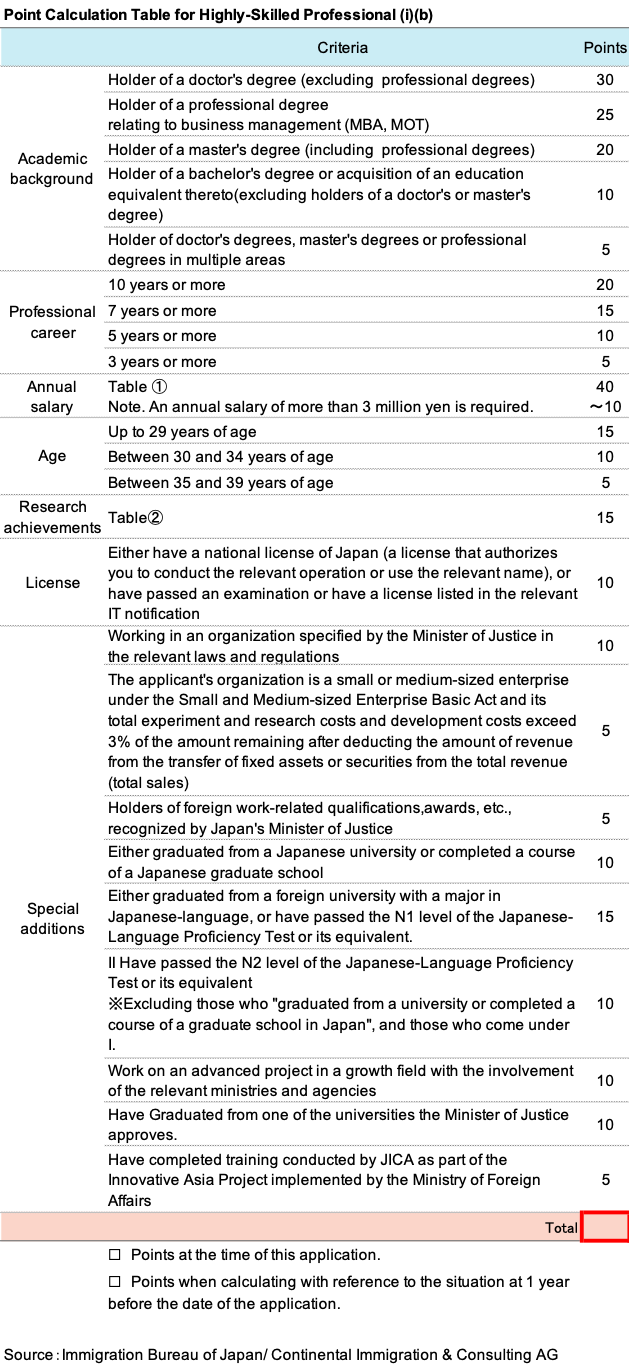
The system evaluates applicants according to factors such as educational qualifications, professional experience, annual remuneration, age, and additional professional achievements.
Applicants who meet the required points threshold can obtain preferential immigration treatment, including longer periods of stay and certain benefits for accompanying family members.
However, the fundamental structure of the points calculation has remained largely unchanged despite substantial developments in Japan’s economic environment.
The government’s current review is intended to address two principal concerns.
First, rising salaries and prices have reduced the relevance of income thresholds established more than a decade ago.
Second, the accumulation of numerous bonus-point categories has made the assessment process increasingly complicated.
The proposed reforms therefore seek to modernize eligibility standards while simplifying administrative examinations.
Higher Salary Thresholds Could Reshape HSP Eligibility
A central element of the review is the relationship between annual income and the points awarded to applicants.
Under the existing framework, salary points vary according to factors including the applicant’s age and professional category.
For example, a qualifying applicant aged 29 or younger with an annual salary of JPY 4 million may currently receive 10 points for income under the applicable calculation table.
The government is considering whether such thresholds remain appropriate in light of higher wage levels.
Possible changes include raising the income required to obtain particular salary points or reducing the points awarded at certain salary levels.
The distinction is important: the government is reviewing the salary-based points structure, not merely proposing a uniform minimum salary requirement for every Highly Skilled Professional applicant.
Because the HSP system combines multiple evaluation factors, a reduction in salary points could be decisive for applicants whose total scores are close to 70 or 80 points.
For example, an individual currently calculating exactly 70 points might fall below the eligibility threshold if the revised system awards fewer points for their salary.
The actual impact will depend on the final regulatory amendments and revised points tables, which have not been specified in the source report.
Understanding the Current 70-Point and 80-Point Rules
The distinction between the two principal point thresholds is essential for understanding the significance of the proposed changes.
| Points | Current immigration significance |
|---|---|
| 70 points or more | May qualify for Highly Skilled Professional (i) status, subject to other applicable conditions |
| 70 points maintained for 3 years | May qualify for an accelerated permanent residence application |
| 80 points maintained for 1 year | May qualify for permanent residence after one year |
| HSP (i) holders | Generally receive a five-year period of stay |
| Qualifying HSP (i) holders | May progress to HSP (ii) after the required period of qualifying activities and satisfaction of additional conditions |
Highly Skilled Professional (ii) offers particularly favorable residence conditions, including an indefinite period of stay, although the status remains subject to applicable immigration rules.
These benefits distinguish Japan’s HSP program from ordinary employment-based residence statuses.
For many foreign professionals, the possibility of applying for permanent residence after just one or three years is one of the system’s strongest incentives.
Accordingly, even relatively modest changes to the points calculation could affect long-term immigration planning.
Bonus Points May Also Be Reduced
The government’s review extends beyond salary-related criteria.
Japan’s HSP points system includes additional points for qualifying achievements and circumstances, such as Japanese language proficiency, specified academic or professional qualifications, and certain research accomplishments.
Over time, additional categories have been incorporated into the framework in response to requests from different government ministries and agencies.
The Ministry of Justice is reportedly reviewing whether some of these categories remain necessary.
Bonus-point provisions that are rarely used may be eliminated, while categories requiring particularly complicated verification could be reconsidered.
Some foreign professional qualifications and research achievements are difficult for immigration examiners to assess because their significance varies across countries and industries.
Evaluating these documents may require additional administrative work, potentially prolonging the examination process.
By reducing the number of evaluation categories, the government hopes to make the system more transparent and efficient.
However, eliminating bonus points could also disadvantage applicants who currently depend on those qualifications to reach the required score.
What Would the Reforms Mean for Foreign Professionals?
The potential consequences will differ according to an applicant’s professional profile.
Foreign professionals with high salaries and substantial academic or professional credentials may remain well positioned under the revised system.
By contrast, younger professionals, early-career researchers, and applicants whose eligibility relies heavily on bonus points could face greater uncertainty.
Three groups deserve particular attention.
Applicants currently scoring between 70 and 79 points
These individuals may be especially sensitive to changes in salary points or bonus categories. A small reduction could affect their eligibility for HSP status or the three-year permanent residence pathway.
Applicants currently scoring 80 points or slightly above
Professionals intending to pursue permanent residence after one year should carefully evaluate the proposed changes. Their ability to demonstrate qualifying points at relevant dates may become particularly important.
Employers recruiting international professionals
Japanese companies, universities, and research institutions may need to reassess remuneration packages and immigration strategies if salary-related scoring becomes more demanding.
For businesses relying on international recruitment, immigration eligibility may become more closely connected to compensation planning and employee retention.
How Does This Relate to Japan’s Permanent Residence Reforms?
The proposed HSP changes arise alongside broader developments in Japan’s permanent residence policy.
Japan’s revised permanent residence guidelines, dated October 1, 2026, introduce more detailed considerations concerning financial independence, projected pension income, Japanese language ability, and integration into Japanese society.
Most of the revised framework is scheduled to apply to applications submitted from April 1, 2027, subject to transitional provisions.
The two policy developments should nevertheless be distinguished.
The permanent residence revisions concern the criteria applied when deciding whether a foreign national should receive permanent resident status.
The HSP points review concerns the method used to identify and evaluate highly skilled foreign professionals.
Although the systems serve different purposes, they intersect because the HSP points calculation also determines access to accelerated permanent residence pathways.
Taken together, these developments suggest that Japan intends to maintain immigration advantages for highly qualified international talent while applying more demanding standards to determine who qualifies.
Will Japan Still Welcome Highly Skilled Foreign Workers?
Yes. The proposed changes do not indicate that Japan intends to discontinue its Highly Skilled Professional immigration program.
On the contrary, the government continues to regard foreign professionals as an important source of innovation, technological expertise, and economic growth.
The number of foreign residents holding Highly Skilled Professional (i) status was approximately 30,000 according to the figures cited in the original report.
The government’s stated objective is to improve the effectiveness of the system rather than eliminate its preferential treatment.
A more selective points framework could therefore coexist with policies designed to encourage talented international professionals to establish careers in Japan.
The challenge will be maintaining an appropriate balance between stronger qualification standards and Japan’s international competitiveness in attracting skilled workers.
Frequently Asked Questions
Is Japan increasing the minimum salary for the Highly Skilled Professional visa?
The government is considering revisions to salary-related points, including higher income thresholds and possible adjustments to points allocation.
However, the final revised salary tables have not been established in the source report. Applicants should distinguish proposed changes from currently effective requirements.
Will 70 points still be sufficient to obtain HSP status?
Under the existing framework, 70 points remains the principal qualifying threshold for Highly Skilled Professional (i), subject to other requirements.
The reported review focuses on how points are awarded. It does not establish that the government has decided to increase the overall 70-point threshold.
Will the one-year permanent residence pathway be abolished?
There is no indication in the reported proposal that Japan intends to abolish the accelerated permanent residence pathway for applicants with 80 or more points.
Nevertheless, a revised calculation system could affect whether particular applicants reach that threshold.
When will the new HSP points rules take effect?
The Ministry of Justice reportedly aims to revise the relevant ministerial regulations during fiscal year 2026, which ends on March 31, 2027.
The precise implementation date and any transitional arrangements will depend on the final regulations.
Should applicants recalculate their HSP points?
Applicants considering HSP status or an accelerated permanent residence application should review their current points calculations and monitor official regulatory developments.
A calculation valid under the existing framework should not automatically be assumed to produce the same result under future rules.
Our Analysis: A More Selective Approach to Global Talent
The proposed reforms highlight a developing tension within Japan’s immigration policy.
Japan needs international professionals capable of supporting innovation and economic competitiveness. At the same time, the government is seeking to strengthen the standards used to determine eligibility for preferential immigration treatment.
Higher salary benchmarks could align the HSP system more closely with contemporary compensation levels.
Simplifying bonus-point categories could improve administrative efficiency and reduce ambiguity in immigration examinations.
However, the effectiveness of these measures will depend on how carefully the revised criteria are designed.
Salary is an important indicator of professional value, but it does not always capture the contribution of younger researchers, startup professionals, or specialists working in emerging fields.
Likewise, eliminating rarely used bonus categories may simplify examinations while reducing recognition of certain specialized qualifications.
The central policy question is therefore not simply whether Japan should make the system stricter.
It is whether the revised framework can identify internationally competitive professionals more accurately without unnecessarily discouraging talent that Japan wishes to attract.
For prospective applicants, one conclusion is already clear: the Highly Skilled Professional points calculation should be treated as an essential component of long-term immigration planning, not merely as an administrative formality.
Professional Advice on Japan’s Highly Skilled Professional Visa
Continental Immigration Administrative Scrivener Corporation specializes in Japanese immigration procedures for highly skilled foreign professionals, international executives, engineers, researchers, and entrepreneurs.
Our services include Highly Skilled Professional eligibility assessments, points calculations, residence status applications, and permanent residence applications under the accelerated HSP pathways.
We also advise applicants and employers on the immigration implications of salary structures, professional qualifications, and career histories.
Continental Immigration Administrative Scrivener Corporation
Japanese Immigration and Permanent Residence Specialists
https://en.continental-immigration.com/
This article discusses proposed regulatory changes reported as of October 2026. The final requirements, implementation date, and transitional arrangements are subject to official government announcements.
About the Author
Masakazu Murai
Administrative Scrivener | Highly Skilled Professional Immigration Specialist
 Masakazu Murai specializes in Japanese immigration law and administrative procedures, with a particular focus on Highly Skilled Professional visas and permanent residence applications.
Before entering immigration practice, he spent approximately 18 years in investment banking at Mitsubishi UFJ Morgan Stanley Securities, advising corporate executives and entrepreneurs on capital markets, corporate finance, and mergers and acquisitions.
His background in both financial advisory and immigration practice provides a distinctive perspective on the relationship between professional qualifications, compensation structures, corporate management, and immigration eligibility.
He holds the Certified Financial Planner (CFP) designation and is a Chartered Member of the Securities Analysts Association of Japan (CMA). He also serves as Vice Branch Director of the Minato Branch of the Tokyo Administrative Scriveners Association.