Japan HSP Type 2 Visa vs. Permanent Residency
Japan’s Highly Skilled Professional (ii) Visa: Requirements, Benefits and Comparison With Permanent Residency
Japan Immigration Guide

Foreign executives, entrepreneurs, investment bankers, consultants and technology professionals planning a long-term career in Japan often consider permanent residency (PR) as their ultimate immigration objective.
However, Japan offers another option that permits an indefinite period of stay: Highly Skilled Professional (ii), commonly known as the HSP Type 2 visa.
Unlike permanent residency, HSP (ii) provides special immigration benefits for qualifying highly skilled professionals and their families, including broader employment activities and preferential arrangements for accompanying parents and domestic workers.
The two statuses serve different purposes. Understanding their requirements is essential when planning a long-term professional career or business investment in Japan.
What Is the Highly Skilled Professional (ii) Visa?
Highly Skilled Professional (ii) is a residence status designed for qualified foreign professionals who have already established a record of highly skilled activities in Japan.
While HSP (i) grants a five-year period of stay, HSP (ii) permits an indefinite period of stay without regular extensions.
Holders may also engage in a wider range of professional activities, including qualifying business management, research and specialist work.
However, HSP (ii) is not equivalent to permanent residency. Holders must continue engaging in qualifying highly skilled activities to maintain their status.
Eligibility Requirements for HSP (ii)
Applicants generally must satisfy the following conditions:
- Qualifying professional experience in Japan: Generally, at least three years of activities under HSP (i), subject to special arrangements for eligible applicants.
- Minimum points: At least 70 points under Japan’s Highly Skilled Professional points system at the time of application.
- Good conduct: Compliance with Japanese laws and applicable immigration obligations.
- National interest: Continued residence must be considered consistent with Japan’s national interests.
- Qualifying activities: Applicants must intend to perform activities within the recognized HSP professional categories, and the proposed activities must be considered appropriate.
Eligibility is not determined solely by holding 70 points or having lived in Japan for three years.
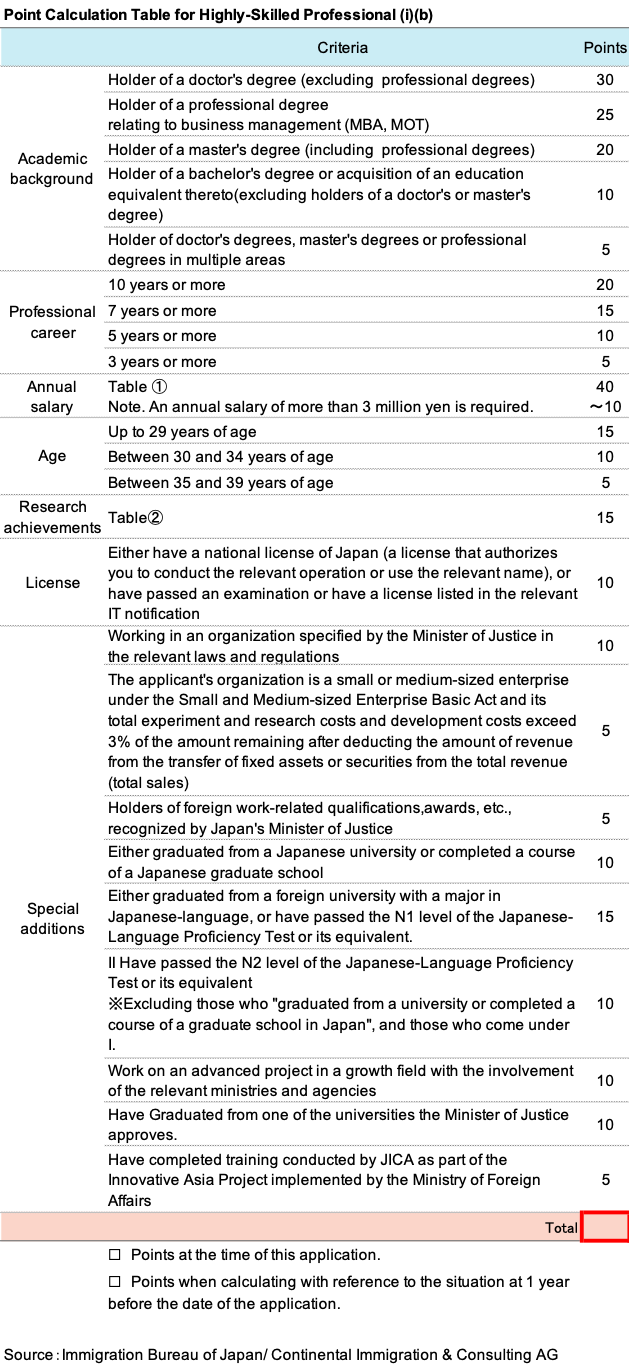
J-Skip: A Faster Route to HSP (ii)
Japan’s Special Highly Skilled Professional system, known as J-Skip, provides an accelerated route for exceptionally qualified professionals.
Under this framework, eligible individuals may qualify for HSP (ii) after approximately one year of qualifying HSP (i) activities rather than the usual three years.
| Professional Category | Principal Eligibility Criteria |
|---|---|
| Advanced Academic Research / Advanced Specialized or Technical Activities | Master’s degree or higher, or at least 10 years of relevant professional experience, plus annual remuneration of at least JPY 20 million |
| Advanced Business Management Activities | At least 5 years of management experience and annual remuneration of at least JPY 40 million |
J-Skip may be particularly relevant to senior investment banking professionals, executives of multinational corporations, experienced technology specialists and internationally active entrepreneurs.
Major Benefits of HSP (ii)
The principal advantage is an indefinite period of stay, removing the need for periodic extensions of residence.
Additional benefits include:
- Broader professional activities: Holders may conduct activities corresponding to almost all employment-related residence categories alongside qualifying HSP activities.
- Spousal employment benefits: Eligible spouses may undertake specified professional work without satisfying certain ordinary academic or experience requirements.
- Parental accompaniment: A parent of the HSP holder or spouse may be permitted to reside in Japan for qualifying childcare or pregnancy-related support, subject to conditions.
- Domestic workers: Eligible households may employ foreign domestic workers under designated immigration arrangements.
These provisions can be especially valuable for foreign executives managing international businesses while raising families in Japan.
Although the period of stay is indefinite, residence cards must still be renewed as required by law.
HSP (ii) vs. Permanent Residency in Japan
Both statuses provide an indefinite period of stay, but they differ substantially in employment freedom, family benefits and immigration security.
| Comparison | Highly Skilled Professional (ii) | Permanent Resident |
|---|---|---|
| Period of stay | Indefinite | Indefinite |
| Extension of period of stay | Not required | Not required |
| Employment activities | Broad, but qualifying HSP activities must continue | Generally unrestricted |
| Retirement or extended unemployment | Status may be revoked following six months without qualifying activities, unless justified | Retirement alone does not constitute grounds for revocation |
| Changing employers / starting a business | Subject to applicable activity and notification requirements | Generally unrestricted |
| Bringing parents to Japan | Special arrangements under specified conditions | No general sponsorship entitlement based solely on PR |
| Employing foreign domestic workers | Special arrangements available | No HSP-specific immigration privilege |
| Spouse’s employment | Preferential arrangements for specified professional activities | A spouse holding Spouse of Permanent Resident status may work without occupational restrictions |
| Revocation of residence status | Nonperformance of qualifying HSP activities may constitute grounds for revocation | Limited to applicable statutory grounds |
Why Retirement and Business Exit Planning Matter
A critical distinction concerns the continued performance of highly skilled activities.
An HSP (ii) holder who stops performing qualifying activities for six consecutive months may face revocation of status, unless a justifiable reason exists.
For example, an executive who sells a company and retires, or an investment banker who leaves employment for an extended career break, should carefully consider the immigration implications.
Permanent residents generally enjoy greater flexibility to change careers, operate businesses, retire or remain outside the workforce without needing to maintain a particular qualifying professional activity.
Which Is Better: HSP (ii) or Permanent Residency?
HSP (ii) may be preferable for foreign professionals who intend to continue working or managing businesses in Japan and wish to benefit from special arrangements for parents, spouses or domestic workers.
Permanent residency may be preferable for those seeking maximum occupational freedom, planning to retire, considering the sale of a business or wishing to establish a long-term home in Japan independently of continued professional activities.
The optimal choice depends on the applicant’s career, household circumstances and future plans.
For some professionals, obtaining HSP (ii) while continuing their careers and subsequently pursuing permanent residency can be a practical strategy.
Japan’s 2026 Permanent Residence Guidelines: What HSP Applicants Should Know
On October 1, 2026, Japan revised its Guidelines for Permission for Permanent Residence.
The revised framework places increased emphasis on household income, projected pension benefits, legal compliance, Japanese language proficiency and integration into Japanese society.
The new income assessment generally considers whether household earnings consistently exceed the national average income of Japanese households of comparable size.
Most changes apply to applications submitted from April 1, 2027, although specific income-related provisions also apply to certain earlier applications.
Importantly, the accelerated permanent residence pathways for highly skilled professionals remain available.
| Highly Skilled Professional Classification | Qualifying Residence Period for PR Application |
|---|---|
| 70 points or more | Generally 3 years |
| 80 points or more | Generally 1 year |
| J-Skip eligible professionals | Generally 1 year |
These shortened periods concern residence-history eligibility. Applicants must also satisfy the other applicable permanent residence requirements.
Holding HSP (ii) status is not a prerequisite for permanent residency. Foreign nationals holding other qualifying residence statuses may also benefit from the accelerated pathways if they can demonstrate the required points and relevant residence history.
The distinction is especially important for professionals considering whether to pursue HSP (ii) or apply directly for permanent residence.
Frequently Asked Questions
Does HSP (ii) allow permanent residence in Japan?
HSP (ii) allows an indefinite period of stay, but it is legally different from Permanent Resident status. Continued qualifying professional activities remain important.
Can I obtain HSP (ii) with 70 points?
Generally, yes, provided you meet the qualifying activity history, good-conduct requirements and other applicable conditions. Seventy points alone do not guarantee approval.
Can I retire in Japan with HSP (ii)?
Extended retirement without qualifying HSP activities may create a risk of status revocation. Permanent residency generally offers more flexibility for retirement.
Is HSP (ii) required before applying for permanent residency?
No. Eligible highly skilled professionals may pursue permanent residence through the 70-point, 80-point or J-Skip pathways without first obtaining HSP (ii).
Immigration Support for Highly Skilled Professionals
 Continental Immigration Administrative Scrivener Corporation has extensive experience supporting foreign entrepreneurs, corporate executives, investment banking professionals and employees of multinational businesses with complex Japanese immigration applications.
Our practice covers HSP (i) and HSP (ii), J-Skip, Business Manager, Engineer/Specialist in Humanities/International Services, Intra-company Transferee and Permanent Resident applications.
For international professionals, immigration eligibility often depends on careful analysis of compensation structures, overseas employment histories, corporate organization, executive responsibilities and business plans.
Drawing on experience in both international finance and immigration practice, our firm assists clients in identifying an appropriate residence status and preparing supporting documentation tailored to their professional and family circumstances.
Whether you are considering HSP (ii) or permanent residency, we can help evaluate your eligibility and long-term immigration options.
Continental Immigration Administrative Scrivener Corporation
Japanese Immigration, Highly Skilled Professional Visas and Permanent Residence Services
https://en.continental-immigration.com/
This article provides general immigration information as of October 2026. Eligibility depends on individual circumstances and applicable laws and administrative practices.